Google Ads experiments: testing my own bidding rule

- Half the budget went to Display banners with zero conversions in three months.
- Fix the account and the tracking first. A test on broken tracking measures noise.
- Then test the bid strategy instead of guessing. The test is still running, and the post says so.
The client is an eCommerce store in Serbia. No brand name, the contract says so. Prices are in Serbian dinars (RSD). For scale, 1 euro is about 117 dinars. A conversion here means an inquiry or a sale, both counted as results.
This post covers two things. What we found when we opened the account, and the experiment we ran once it was fixed. The experiment is the reason I'm writing it. It ends on November 13, and the numbers below are a snapshot from roughly halfway through. I'll update this page with the final result.
Where the money was going
June to August, the account spent about 188,000 RSD. One Search campaign, bidding on Maximize Clicks. That sounds simple. The report said something else.
| June to August | Spend | Clicks | Conversions |
|---|---|---|---|
| Display Network | ~94,200 RSD | ~14,500 | 0 |
| Google Search | ~93,900 RSD | ~2,570 | 1 recorded |

A Search campaign has a checkbox called Display Network. It's on by default. When it's on, your search ads also run as banners on websites and apps. Nobody turned it off.
Now add the bid strategy. Maximize Clicks has one job: get as many clicks as the budget allows. Display clicks cost 6 to 7 RSD. Search clicks cost about 36. So the system did exactly what it was told and moved half the budget to the cheapest clicks it could find. Those clicks never converted.
Why didn't anyone notice? Because conversion tracking was broken too. One conversion recorded in three months. With no conversion data, every channel looks equally bad, so the cheap one looks efficient.
- Campaigns, open each Search campaign, Settings, Networks
- Is "Include Google Display Network" ticked
- Segment the campaign by Network and compare spend to conversions
Fix first, test second
In September we rebuilt the account. Campaigns consolidated, conversion tracking set up again from scratch, Display Network switched off at the start of the month.
The order matters. An experiment compares conversions. If the account can't count conversions, the experiment compares two kinds of noise and picks a winner anyway. Tracking is the scale. You calibrate the scale before you weigh anything. I wrote more about that in three ways conversion tracking breaks quietly.
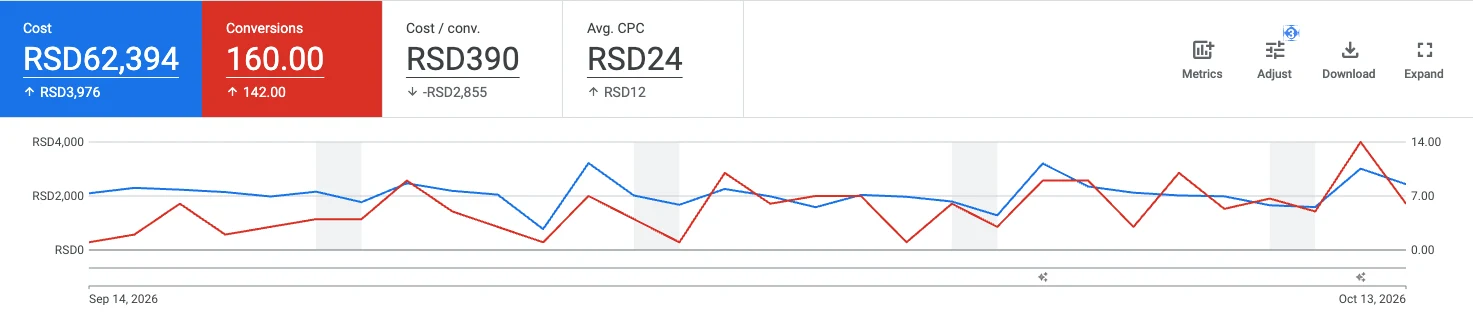
Don't read that jump as pure performance. A big part of it is conversions finally being counted. That's the point of fixing tracking first: from here on the numbers mean something, and a test can use them.
The experiment: Maximize Clicks vs Maximize Conversions
Here's the part that's a little awkward for me. My own account method says: under 30 conversions a month, run Maximize Clicks to collect signal. This account was close to that line. So the default in my own method is what got tested.
On some accounts I test bidding from day one. On a few of them Maximize Conversions beat the default from the start. That is why the rule is a starting point, and the test decides.
Google Ads has a built-in tool for this, under Campaigns, Experiments. It splits a campaign's traffic in two. The original (control) keeps its settings. The copy (treatment) gets one change. Both run in the same weeks, in the same auctions, with the same budget. That's what makes it fair. A before-and-after comparison can't separate your change from a holiday, a sale or a competitor going quiet. An experiment can.
- Name: Bidding test
- Dates: September 19 to November 13, 2026
- Control: Maximize Clicks
- Treatment: Maximize Conversions
- Network: Search only, in both arms
- Campaigns in the test: two, here called A and B
The snapshot, about halfway in:
| Campaign A | Max Clicks | Max Conversions |
|---|---|---|
| Spend | 12,615 RSD | 12,633 RSD |
| Clicks | 936 | 414 |
| Avg. CPC | 13 RSD | 31 RSD |
| Conversions | 29 | 51 |
| Cost per conversion | 435 RSD | 248 RSD |
| Campaign B | Max Clicks | Max Conversions |
|---|---|---|
| Spend | 7,067 RSD | 6,872 RSD |
| Clicks | 550 | 260 |
| Avg. CPC | 13 RSD | 26 RSD |
| Conversions | 14 | 37 |
| Cost per conversion | 505 RSD | 186 RSD |
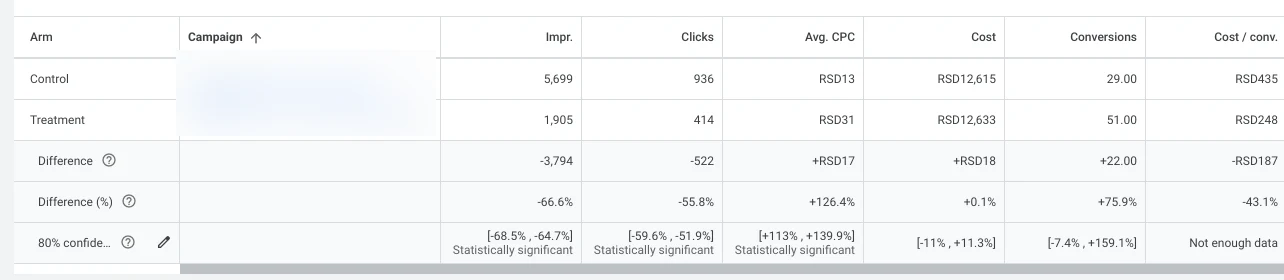
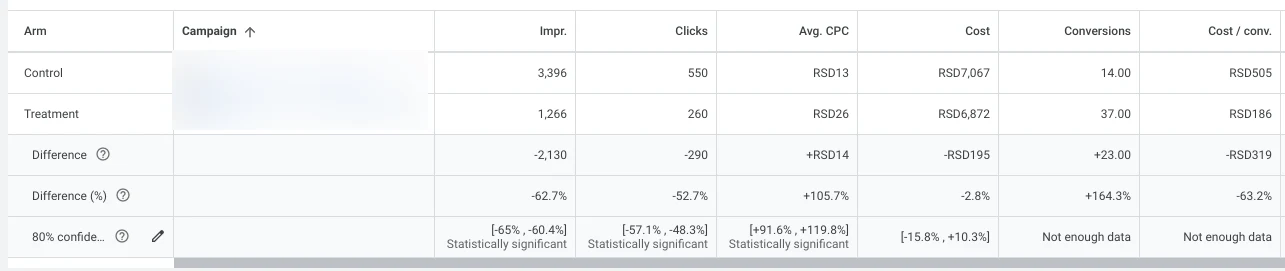
Same story as the Display problem, on a smaller scale. Maximize Clicks found cheaper clicks. Maximize Conversions paid more than double per click and got more conversions. A cheap click is only cheap if it converts.
How to read this without fooling yourself
The interface shows a green "Treatment arm winning" label. It's tempting to stop the test, apply the winner and move on. Look one line lower first.
For campaign A, Google estimates the conversion difference at +75.9%, with an 80% confidence range from -7.4% to +159.1%. In plain words: based on the data so far, the real effect could be anywhere from slightly worse to more than twice as good. Because the range still includes zero and below, Google marks it as not statistically significant. Campaign B (+164.3%) gets "not enough data yet".
The click and CPC differences, on the other hand, are significant. We know for sure that the two strategies buy different traffic. We don't know yet, with enough confidence, how big the conversion difference is.
One thing does count in the treatment's favor: both campaigns point the same way. That's worth noting. It's still not a verdict.
Why run experiments at all
Every Google Ads account runs on defaults. Google's defaults, the agency's defaults, mine. A default is a guess that worked often enough somewhere else. This account is a good example of both kinds failing: a checkbox nobody looked at, and a bidding rule from my own method that may not fit this store.
- A test answers a question your account is actually asking. Not "what works for most stores", but what works here, with these products and these margins.
- The comparison is fair. Same weeks, same auctions, same budget. Before-and-after can't give you that.
- Bad changes stay small. If the new setting is worse, only half the traffic paid for finding out.
- It forces you to decide the metric upfront. Here that's conversions and cost per conversion, not clicks. Clicks would have picked the wrong winner.
And one rule that sits under all of it: the test is only as good as the tracking. Fix the scale, then weigh.
The test ends and I'll add the final numbers and screenshots here. If the conversion difference holds and becomes significant, that's the answer. If it doesn't, that's an answer too: the difference is too small to bet the account on, and the decision goes back to cost per conversion against the store's breakeven.
Not sure what your account would test first?
A Written Diagnosis reads your account end to end and tells you, in plain language, what's broken, what to fix before testing anything, and in what order.
Senior Google Ads operator with 8+ years of experience, spent the last years almost entirely inside DTC eCommerce accounts. Small number of accounts, no juniors, no handoffs.